
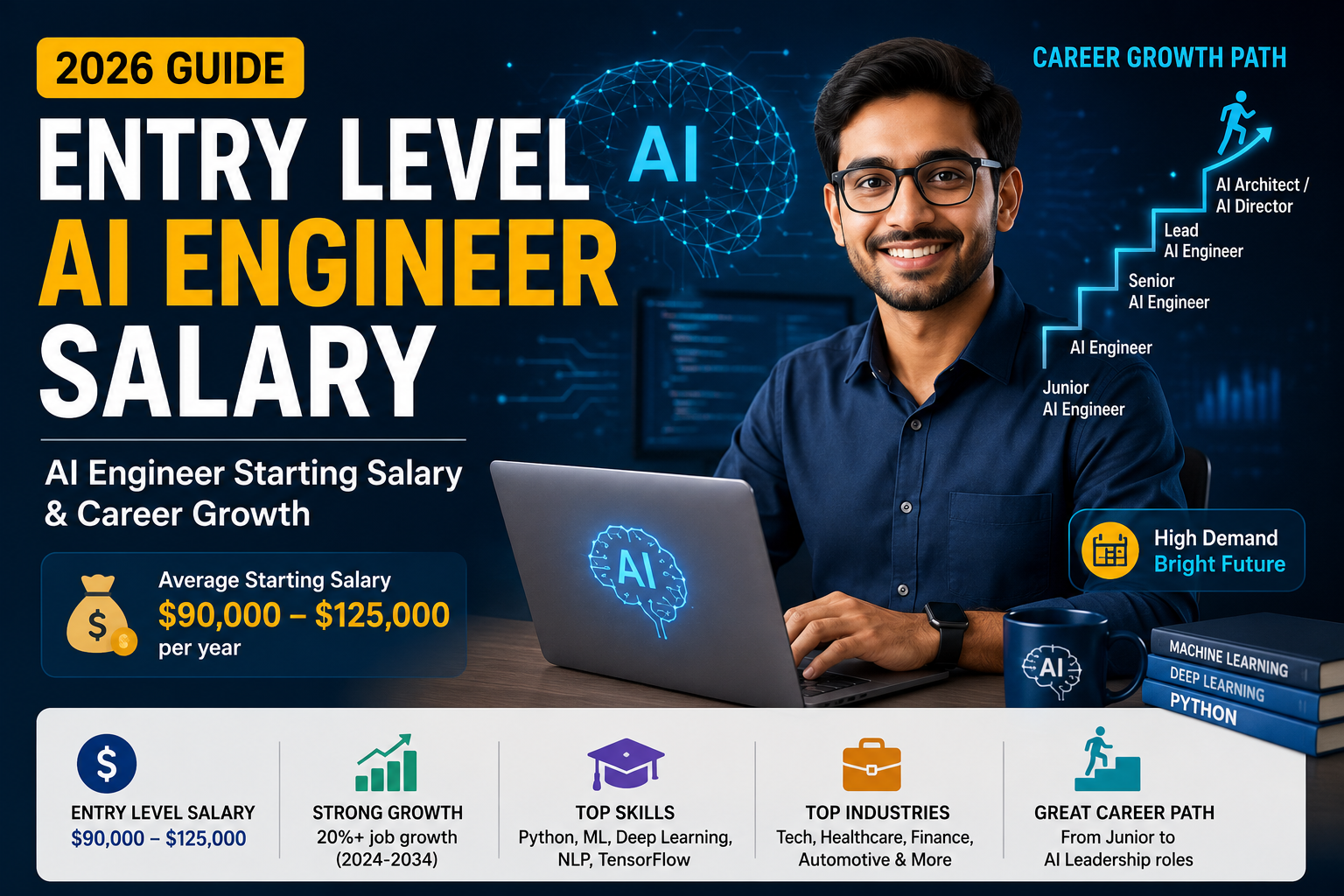
Entry Level AI Engineer Salary
Entry Level AI Engineer Salary is one of the most searched topics among students, recent graduates, and professionals planning a career in artificial intelligence. As AI continues transforming industries such as healthcare, finance, manufacturing, and technology, companies are investing heavily in AI talent. This growing demand has made AI engineering one of the highest-paying career paths in the technology sector.
If you’re wondering how much an entry-level AI engineer earns, which companies offer the best salaries, and what skills can increase your income, this guide covers everything you need to know. Whether you’re preparing for your first AI job or planning a career switch, understanding salary trends can help you make informed decisions.
Table of Contents
- What Is an AI Engineer?
- Entry Level AI Engineer Salary in 2026
- Salary by Country
- Salary by Experience
- Highest-Paying Companies
- Factors That Affect AI Engineer Salaries
- Skills That Increase Your Salary
- Education Requirements
- Career Growth
- FAQs
- Conclusion
What Is an AI Engineer?
An AI Engineer develops intelligent software systems capable of solving problems, recognizing patterns, and making predictions using machine learning, deep learning, and data analysis.
AI Engineers build applications such as:
- Chatbots
- Recommendation systems
- Voice assistants
- Self-driving technology
- Fraud detection systems
- Medical diagnosis tools
- Predictive analytics platforms
Their work combines programming, mathematics, and data science to create real-world AI solutions.
Entry Level AI Engineer Salary in 2026
The Entry Level AI Engineer Salary varies depending on location, company, education, technical skills, and industry. In countries with a strong technology sector, AI engineers often receive competitive salaries even in their first professional role.
In the United States, entry-level AI engineers commonly earn between $90,000 and $125,000 per year. Professionals with internships, certifications, or strong portfolios may receive higher starting offers.
Many employers also provide additional benefits such as:
- Performance bonuses
- Health insurance
- Paid leave
- Retirement plans
- Remote work options
- Learning and certification budgets
- Stock options (at some companies)
AI Engineer Entry Level Salary by Country
| Country | Average Entry-Level Salary |
|---|---|
| United States | $90,000–$125,000 |
| Canada | CAD 75,000–100,000 |
| United Kingdom | £40,000–£60,000 |
| Germany | €55,000–€75,000 |
| Australia | AUD 90,000–120,000 |
| Singapore | SGD 70,000–100,000 |
Salary levels depend on experience, local demand, company size, and cost of living.
Salary by Experience
| Experience | Average Annual Salary |
| Entry Level (0–1 Year) | $90,000–$125,000 |
| 1–3 Years | $120,000–$155,000 |
| 3–5 Years | $150,000–$190,000 |
| Senior AI Engineer | $190,000–$260,000+ |
As professionals gain hands-on experience with AI frameworks and production systems, their earning potential generally increases.
Top Companies Hiring Entry-Level AI Engineers
Several global technology companies recruit graduates and junior AI engineers each year. Some of the best-known employers include:
- Microsoft
- Amazon
- NVIDIA
- Apple
- Meta
- IBM
- Oracle
- Intel
- Adobe
These organizations often offer competitive salaries, structured training, and opportunities to work on cutting-edge AI projects.
Factors That Affect Entry Level AI Engineer Salary
Several factors influence how much an AI engineer earns at the start of their career.
1. Education
Candidates with degrees in Computer Science, Artificial Intelligence, Software Engineering, or Data Science are often preferred.
2. Technical Skills
Knowledge of Python, Machine Learning, Deep Learning, SQL, TensorFlow, PyTorch, and cloud platforms can improve salary prospects.
3. Company Size
Large multinational companies may offer higher salaries and more comprehensive benefits than smaller organizations.
4. Location
Technology hubs such as Silicon Valley, Seattle, New York, and Austin often provide higher salaries because of increased demand and living costs.
5. Internship Experience
Relevant internships and practical projects demonstrate real-world experience and can make candidates more competitive.
Skills That Can Increase Your Salary
Developing in-demand skills can help you qualify for higher-paying positions.
Some of the most valuable AI skills include:
- Python Programming
- Machine Learning
- Deep Learning
- Natural Language Processing (NLP)
- Computer Vision
- TensorFlow
- PyTorch
- SQL
- Data Analysis
- AWS
- Microsoft Azure
- Docker
- Kubernetes
- Git
- Generative AI
Employers also value communication, teamwork, and problem-solving abilities.
External Resources
For additional career and labor market information, consider linking to these trusted sources:
- U.S. Bureau of Labor Statistics (BLS): https://www.bls.gov
- O*NET OnLine: https://www.onetonline.org
- LinkedIn Jobs: https://www.linkedin.com/jobs
- Indeed Careers: https://www.indeed.com
- Glassdoor: https://www.glassdoor.com
Featured Image
Image Title: Entry Level AI Engineer Salary 2026
ALT Text: Entry Level AI Engineer Salary guide showing AI engineer starting salary and career growth in 2026
Career Growth for AI Engineers
Artificial Intelligence is one of the fastest-growing industries in the world. As businesses continue adopting AI-powered solutions, the demand for skilled AI engineers is expected to increase significantly over the coming years.
A typical career path looks like this:
- Junior AI Engineer
- AI Engineer
- Machine Learning Engineer
- Senior AI Engineer
- Lead AI Engineer
- AI Architect
- Head of AI / Director of AI
- Chief AI Officer (CAIO)
With continuous learning and hands-on experience, many AI engineers can substantially increase their salary within a few years.
How to Become an AI Engineer
If you’re starting from scratch, follow these practical steps:
1. Earn a Relevant Degree
A bachelor’s degree in Computer Science, Artificial Intelligence, Data Science, Software Engineering, or Information Technology provides a strong foundation.
2. Learn Programming
Python is the most commonly used language in AI development. Learning SQL and basic Java or C++ can also be helpful.
3. Study Machine Learning
Understand key concepts such as:
- Supervised Learning
- Unsupervised Learning
- Reinforcement Learning
- Neural Networks
- Deep Learning
4. Build Real Projects
Create projects such as:
- Chatbots
- Image Recognition Systems
- Recommendation Engines
- Sentiment Analysis Tools
- AI Resume Screeners
A portfolio of practical projects demonstrates your abilities to employers.
5. Earn Professional Certifications
Well-recognized certifications can strengthen your resume, including:
- AWS Certified Machine Learning
- Microsoft Azure AI Engineer Associate
- Google Professional Machine Learning Engineer
- IBM AI Engineering Professional Certificate
6. Apply for Entry-Level AI Jobs
Focus on roles such as:
- Junior AI Engineer
- Machine Learning Engineer
- AI Developer
- Data Scientist
- Computer Vision Engineer
- NLP Engineer
Highest-Paying Industries for AI Engineers
AI professionals are in demand across many industries. Some of the highest-paying sectors include:
| Industry | Salary Potential |
|---|---|
| Artificial Intelligence | ⭐⭐⭐⭐⭐ |
| Cloud Computing | ⭐⭐⭐⭐⭐ |
| Healthcare Technology | ⭐⭐⭐⭐⭐ |
| Financial Technology (FinTech) | ⭐⭐⭐⭐⭐ |
| Cybersecurity | ⭐⭐⭐⭐ |
| Robotics | ⭐⭐⭐⭐ |
| Automotive & Autonomous Vehicles | ⭐⭐⭐⭐ |
| E-commerce | ⭐⭐⭐⭐ |
Best Websites to Find AI Engineer Jobs
Start your job search on trusted platforms:
- LinkedIn Jobs
- Indeed
- Glassdoor
- Wellfound
- Dice
- Google Careers
- Microsoft Careers
- Amazon Jobs
When applying, customize your resume for each role and highlight projects, internships, certifications, and technical skills.
Tips to Increase Your Entry Level AI Engineer Salary
If your goal is to earn above the average Entry Level AI Engineer Salary, consider these strategies:
- Learn Generative AI technologies.
- Master Python and SQL.
- Build a strong GitHub portfolio.
- Contribute to open-source AI projects.
- Complete internships before graduation.
- Earn industry-recognized certifications.
- Stay updated with the latest AI tools and frameworks.
- Develop communication and teamwork skills.
These steps can improve both your employability and your earning potential.
Common Mistakes to Avoid
Avoid these common career mistakes:
- Applying without tailoring your resume.
- Ignoring portfolio development.
- Skipping interview preparation.
- Learning only theory without building projects.
- Not improving communication skills.
- Applying to jobs without reading the requirements carefully.
Frequently Asked Questions (FAQs)
What is the average Entry Level AI Engineer Salary?
In the United States, entry-level AI engineers commonly earn between $90,000 and $125,000 per year, although compensation varies based on location, company, and experience.
Is AI engineering a good career?
Yes. AI engineering offers strong demand, competitive salaries, and opportunities to work on innovative technologies across multiple industries.
Which country pays AI engineers the highest salaries?
The United States is among the highest-paying markets for AI engineers, especially in major technology hubs. Other countries, such as Canada, the United Kingdom, Germany, Australia, and Singapore, also offer attractive salaries depending on the role and employer.
Can fresh graduates become AI engineers?
Yes. Many companies hire graduates for junior or entry-level AI positions, especially candidates with relevant projects, internships, and technical skills.
Which programming language is best for AI?
Python is widely regarded as the leading programming language for artificial intelligence because of its extensive ecosystem of AI and machine learning libraries.
Conclusion
The Entry Level AI Engineer Salary continues to attract students and professionals because AI remains one of the fastest-growing technology fields. Entry-level salaries are already competitive, and there is significant potential for career advancement as you gain experience and develop specialized skills.
To maximize your earning potential, focus on learning Python, machine learning, cloud computing, and modern AI frameworks. Build real-world projects, earn recognized certifications, and keep your portfolio updated. These steps can help you stand out in a competitive job market and secure rewarding opportunities with leading employers.
Authoritative External Links
For reliable career and employment information, link to:
- U.S. Bureau of Labor Statistics: https://www.bls.gov
- O*NET OnLine: https://www.onetonline.org
- LinkedIn Jobs: https://www.linkedin.com/jobs
- Indeed Careers: https://www.indeed.com
- Glassdoor: https://www.glassdoor.com